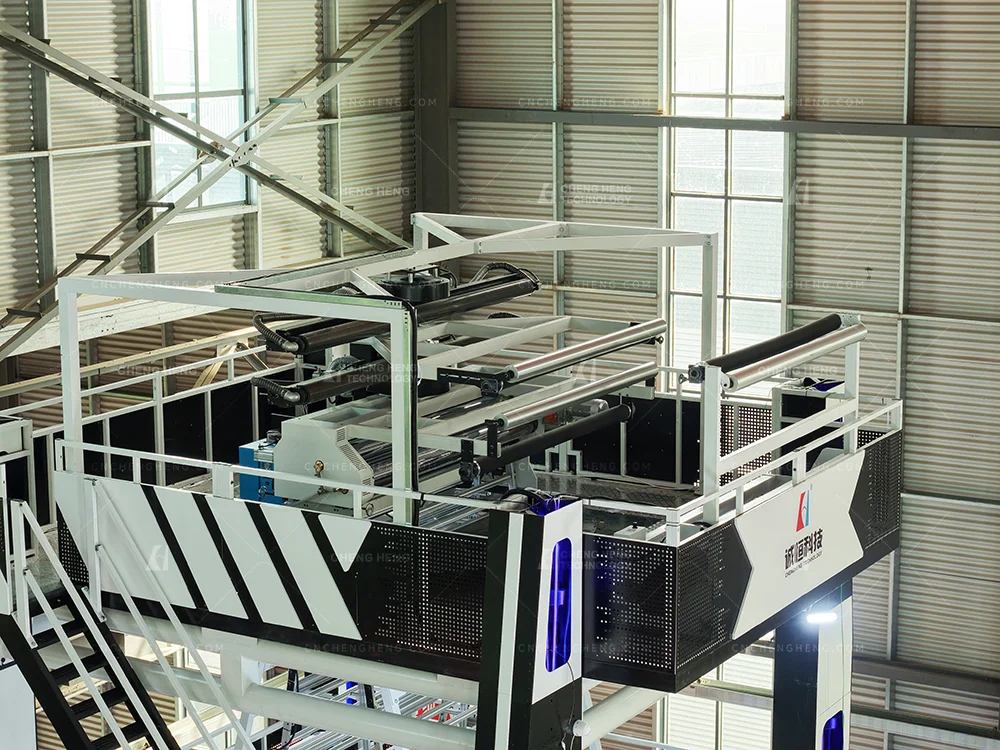
Blown film extrusion is a highly dynamic manufacturing process influenced by numerous variables, including:
Resin characteristics
Melt temperature
Extrusion pressure
Cooling air distribution
Ambient environmental conditions
Bubble stability
Haul-off speed
Traditionally, operators rely on experience to adjust these parameters. While skilled technicians can achieve good results, manual adjustments often introduce variability and require longer stabilization times, particularly when changing materials or production specifications.
As packaging customers demand tighter thickness tolerances and higher quality consistency, manufacturers are increasingly looking for intelligent systems capable of monitoring and optimizing production in real time.
Unlike conventional automation systems that react only after deviations occur, AI algorithms continuously analyze large volumes of production data to identify patterns that may indicate future quality issues.
By integrating machine learning models with process sensors, manufacturers can predict changes before defects become visible.
Typical AI-assisted optimization includes:
Predicting bubble instability before collapse
Detecting abnormal temperature fluctuations
Optimizing cooling airflow distribution
Recommending extrusion parameter adjustments
Forecasting product quality trends
Rather than replacing experienced operators, AI functions as an intelligent decision-support system that helps engineers make faster and more accurate process adjustments.
Recent smart manufacturing research highlights AI and machine learning as key technologies for predictive process control, digital twins, industrial sensing, and sustainable manufacturing.
Film thickness uniformity remains one of the most critical quality indicators in blown film production.
Even small deviations can result in:
Increased resin consumption
Reduced mechanical strength
Poor printing performance
Inconsistent sealing quality
Higher customer rejection rates
AI systems integrated with online thickness measurement equipment can continuously analyze thickness profiles while learning how process variables influence product quality.
When combined with automatic air ring systems and closed-loop profile control, AI can recommend—or in advanced installations automatically implement—parameter adjustments that improve gauge consistency and reduce unnecessary over-gauging.
The result is higher product quality with lower raw material consumption.
Material waste remains one of the largest operating costs in film production.
Waste is commonly generated during:
Machine startup
Product changeovers
Process instability
Bubble breakage
Thickness correction
Quality inspection
AI helps minimize these losses by shortening the time required to stabilize production after startup and by detecting process abnormalities earlier than traditional monitoring systems.
Predictive maintenance algorithms can also identify equipment conditions that may lead to unplanned downtime or quality fluctuations, allowing maintenance teams to intervene before failures occur.
Across manufacturing, data-driven process control and AI-assisted optimization are increasingly being used to improve resource efficiency and reduce production waste.
The growing use of recycled polyethylene (PCR) introduces additional complexity into blown film production.
Compared with virgin resin, recycled materials often exhibit greater variation in:
Melt flow characteristics
Moisture content
Contamination levels
Mechanical properties
These variations make stable processing more challenging.
AI models trained on historical production data can help manufacturers identify optimal processing windows for different material blends, allowing operators to maintain stable production while increasing recycled content.
This capability supports both production efficiency and sustainability objectives.
Recent research into circular plastics manufacturing also emphasizes AI-driven optimization as a tool for improving the use of recycled materials and adaptive process control.
Another emerging trend is the use of digital twin technology.
A digital twin creates a virtual representation of a production line by combining real-time sensor data with AI-based simulation models.
Engineers can use these virtual environments to:
Test process adjustments before implementation
Simulate new product recipes
Predict production performance
Optimize energy consumption
Evaluate maintenance strategies
As computing power and industrial connectivity continue to improve, digital twins are expected to become increasingly common in advanced film extrusion facilities.
The adoption of AI is changing how manufacturers measure competitiveness.
Instead of focusing solely on machine speed, producers are increasingly evaluating:
Material utilization efficiency
Overall equipment effectiveness (OEE)
Energy consumption
Production stability
Predictive maintenance performance
Data-driven quality management
Manufacturers capable of integrating AI with intelligent extrusion equipment will be better positioned to meet growing customer expectations while controlling production costs.
Over the next decade, AI is expected to become a standard component of modern blown film production lines rather than an optional upgrade.
Future developments may include:
Self-optimizing extrusion systems
Autonomous process control
AI-assisted quality inspection
Cloud-based production analytics
Real-time energy optimization
Generative AI tools for process engineering
Rather than replacing human expertise, AI will enhance decision-making by allowing operators and engineers to focus on strategic optimization while intelligent systems manage routine adjustments.
Hebei Chengheng Plastic Machinery Technology Co., Ltd. specializes in the development and manufacture of advanced blown film extrusion equipment, automatic air ring systems, online thickness measurement systems, and intelligent automation solutions.
Committed to continuous innovation, the company provides customized technologies that help film manufacturers improve production efficiency, enhance product quality, reduce material waste, and support the transition toward smarter and more sustainable manufacturing.
2026 Roadmap on Artificial Intelligence and Machine Learning for Smart Manufacturing (international roadmap on AI/ML in smart manufacturing).
Elsevier, Data-driven Decision Support and Control for Adaptive Circular Production of Plastics (2026).
Springer Nature, Towards a Circular Plastics Economy: Synchronising Material Design, Hybrid Processing, Digital Logistics, and Adaptive Policy (2026).
Journal of Environmental Management, Recent Advances in Plastic Waste Management: A Systems-Level Framework for Circular Plastic Economy Strategies (2026).