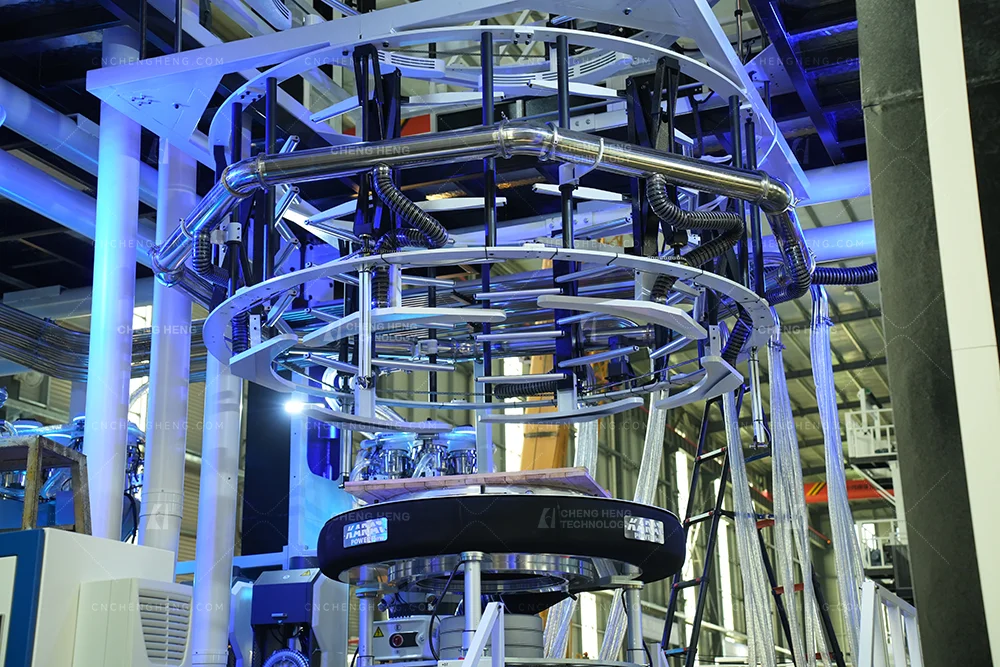
The global packaging industry is witnessing a significant shift toward operational lean manufacturing, where the optimization of floor space and energy consumption has become a critical engineering priority. In the production of polyethylene films, the traditional reliance on multiple single-head extruders often leads to redundant power systems and excessive workshop footprint, creating bottlenecks in high-volume production environments.
The technical challenge lies in maintaining precise thickness control and material homogeneity while increasing output. For manufacturers producing a diverse range of small-width films—such as T-shirt bags and shopping bags—the need for a versatile system that can handle multiple specifications without duplicating the entire machinery footprint is paramount.
This analysis examines the engineering logic behind the twin-head configuration of a blown film production line, evaluating how integrated extrusion systems resolve the conflict between production capacity and resource efficiency.


The twin-head architecture operates on the principle of a single screw cylinder feeding two independent die heads. This configuration allows a single extrusion unit to drive two separate film bubbles, each equipped with its own upper traction system and winder. This design is specifically engineered for small-width applications where LDPE and HDPE resins are processed into rolls.
By utilizing high-quality alloy steel for both the cylinder and the screw, treated via nitration and precision finishing, the system ensures maximum hardness and corrosion resistance. This material choice is critical for preventing premature wear when processing recycled materials or CaCO3-filled resins.
The performance of a film blowing system is dictated by the L/D ratio of the screw and the motor capacity. For these twin-head systems, an L/D ratio of 32:1 with force feeding is employed to ensure consistent melt pressure, which is essential when splitting the flow between two die heads. Main motor capacities range from 15kw to 37kw, depending on the target output and resin viscosity.
Film thickness capabilities are highly specialized: HDPE can be produced from 0.008mm to 0.08mm, while LDPE ranges from 0.02mm to 0.12mm. These narrow tolerances are achieved through precision die diameters (Φ50mm to Φ80mm) and calibrated cooling systems that stabilize the bubble as it ascends.
Output rates are scaled according to the model, with the largest configurations reaching 120kg/h. This throughput is achieved by optimizing the screw diameter (up to Φ65) and ensuring the gearbox (up to 200#) can handle the torque required for simultaneous dual-stream extrusion.
From an industrial engineering perspective, the primary advantage of the twin-head setup is the reduction of redundant hardware. In a traditional setup, two separate lines would require two sets of main power supplies and two independent cooling water pumps.
Operational flexibility is enhanced through independent head control. This allows for simultaneous production of films with different widths or thicknesses—for instance, food-grade PE on one head and industrial-grade PE on the other—without requiring a complete system shutdown for material changeovers.
Evaluating the efficiency of a twin-head system involves analyzing the trade-off between capital expenditure (CAPEX) and operational expenditure (OPEX). When compared to multiple single-head lines, the shared components reduce the initial cost of acquisition and the long-term maintenance burden.
The following assessment provides a normalized engineering rating across five key performance dimensions, illustrating the relative strengths of the twin-head configuration in a modern production facility.
In representative industrial application scenarios, these systems are deployed for the mass production of T-shirt bags and rolling bags. The capability to produce two film rolls simultaneously from a single extruder allows manufacturers to fulfill dual-order requirements—such as different thicknesses for the same material—without switching lines, thereby minimizing downtime.
Integration into the wider workflow typically involves pairing the blowing line with automated bag-making and printing machinery. Because the twin-head system outputs two independent rolls, it requires a coordinated winder-to-bag-machine logistics flow to maintain maximum efficiency.
The industry is moving toward higher ratios of biodegradable and recycled polymers. This transition requires extrusion systems with superior thermal stability and screw designs that can handle the inconsistent melt flow indices of recycled HDPE and LDPE without compromising the film's tensile strength.
Digitalization is also penetrating the blowing process. Future engineering requirements will likely include integrated sensor arrays for real-time bubble diameter monitoring and automated thickness adjustment, reducing the reliance on manual sampling and decreasing material waste.
Furthermore, the demand for multi-layer structures (ABC films) is increasing to improve barrier properties. While the twin-head system excels in volume and efficiency for single or double layer films, the integration of multi-layer co-extrusion within compact frames remains a key R&D direction.
Selecting the appropriate configuration for a blown film production line requires a detailed analysis of the target film width and the intended raw materials. A wider die diameter is necessary for larger bubble stability, while the screw diameter determines the overall hourly output.
Buyers must balance the output requirements against the available power infrastructure. For instance, a high-duty configuration with a 37kw motor is suited for continuous 24/7 operation, whereas standard configurations are more appropriate for intermittent, specialized batch runs.
The following matrix provides a technical comparison of typical configuration profiles to assist in engineering decision-making.
| Configuration Profile | Max Film Width | Max Output | Recommended Use Case |
|---|---|---|---|
| Basic Profile | 300mm | 90kg/h | Small-scale T-shirt bags |
| Standard Profile | 500mm | 100kg/h | General retail shopping bags |
| High-Duty Profile | 550mm | 120kg/h | Industrial rolling film |
| Precision Profile | 300mm | 60kg/h | Ultra-thin HDPE membranes |
| Recycled Profile | 400mm | 80kg/h | Post-consumer PE processing |
| Industry Baseline | 400mm | 90kg/h | Mixed HDPE/LDPE production |
To ensure long-term durability and resistance to the corrosive nature of some plastic resins, the screw and cylinder should be manufactured from high-quality alloy steel. The application of nitration and precision finishing is essential to achieve the necessary hardness and surface smoothness, which prevents material stagnation and reduces wear during the extrusion process.
The system integrates two die heads, two traction units, and two winders into a single machine frame. This architecture reduces the physical footprint by over 50% compared to operating two separate single-head lines. Additionally, it minimizes energy costs by sharing a single main motor and cooling water pump system across both production streams.
While both heads share the same melt stream from the single extruder, the independence of the die heads and traction systems allows for different film widths and thicknesses. However, processing fundamentally different materials (e.g., LDPE vs HDPE) simultaneously is not possible since they share one screw; the system is designed for different specifications of the same or compatible resin types.
The Length-to-Diameter (L/D) ratio of 32:1 provides sufficient residence time for the polymer to be fully melted and homogenized. In a twin-head system, this is critical to ensure that the melt pressure is stable and equalized before the material splits into the two die heads, preventing uneven thickness between the two produced films.
The choice depends primarily on the required output (kg/h). The Φ50 screw is suitable for lower output requirements (up to 90kg/h) and smaller film widths. For high-volume production reaching 120kg/h, the Φ65 screw is necessary to handle the higher mass flow rate and provide the required torque for industrial-scale output.
While nitrated alloy steel is highly wear-resistant, regular inspection of the screw flights and cylinder inner walls is recommended, especially when using recycled materials or CaCO3 fillers. Monitoring the melt pressure and temperature stability can indicate when the precision finishing is beginning to wear, signaling the need for refurbishment to maintain film quality.
The transition toward twin-head extrusion represents a logical evolution in the effort to maximize output while minimizing the industrial footprint. By consolidating the power and extrusion architecture while maintaining independent output control, manufacturers can achieve a significant reduction in both CAPEX and OPEX.
Ultimately, the success of a blown film production line in a competitive market depends on the balance of material versatility, energy efficiency, and precise thickness control. Integrating these systems allows for a more agile response to diverse order requirements without the inefficiency of redundant machinery.