Unlike traditional retail, e-commerce requires products to travel through multiple stages of storage, sorting, transportation, and last-mile delivery before reaching consumers.
This places different requirements on packaging.
Products must be protected against:
Impact during transportation
Compression and abrasion
Moisture exposure
Handling throughout distribution centers
Repeated movement through logistics networks
At the same time, packaging must remain lightweight and economical because shipping costs are closely connected to package weight and dimensions.
Flexible packaging is well suited to these requirements because plastic films can provide protection while using relatively little material.
The latest market research points to continued expansion of flexible packaging within the broader e-commerce packaging sector.
Mordor Intelligence estimates that the global e-commerce packaging market could increase from approximately US$78.39 billion in 2025 to US$89.07 billion in 2026, with further growth projected through 2031. Its market analysis specifically identifies flexible films and mailers as part of the expanding e-commerce packaging landscape.
Another August 2026 market analysis from Fortune Business Insights estimates the global flexible plastic packaging market at approximately US$176.18 billion in 2026, with projected growth to more than US$282 billion by 2034. E-commerce is included among the major end-use sectors supporting market demand.
Although market forecasts vary depending on methodology and market definition, the overall direction is consistent: flexible packaging remains an important growth area within the global packaging industry.
Plastic films offer several characteristics that make them particularly useful for online retail and logistics applications.
Film-based packaging can provide protection without adding significant weight to shipments.
This can help reduce transportation costs and improve logistics efficiency.
Flexible films can accommodate products with different shapes and sizes, making them suitable for a wide variety of e-commerce applications.
Polyethylene-based films can provide an effective barrier against moisture, helping protect products during transportation and storage.
Modern film structures can achieve required mechanical performance while reducing unnecessary material consumption.
These characteristics have helped flexible packaging become an important component of modern e-commerce logistics.
Market growth alone does not guarantee success for film manufacturers.
E-commerce packaging is increasingly expected to combine durability, appearance, convenience, and sustainability.
For film producers, this creates demand for products with improved:
Puncture resistance
Tear resistance
Seal strength
Impact performance
Thickness consistency
Optical properties
At the same time, customers increasingly expect packaging suppliers to reduce material consumption and improve recyclability.
This creates a technical challenge: manufacturers must produce films that deliver higher performance while using materials more efficiently.
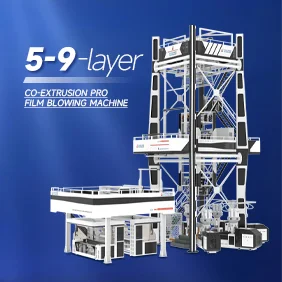
The blown film extrusion process plays a central role in the production of many flexible packaging films.
As product requirements become more demanding, manufacturers are investing in more precise extrusion technologies to improve film consistency and production efficiency.
Modern blown film lines can incorporate:
Automatic air ring systems
Online thickness measurement
Automatic thickness profile control
Intelligent temperature management
Digital production monitoring
These technologies help manufacturers maintain stable production conditions and improve film quality.
For high-volume e-commerce packaging applications, even small improvements in material utilization can produce significant cost savings when multiplied across thousands of tonnes of annual production.
One of the major challenges facing packaging manufacturers is balancing performance with material reduction.
Using too much material increases cost and packaging waste. Using too little may compromise the mechanical performance required for transportation.
Accurate thickness control therefore becomes particularly important.
Online measurement systems can continuously monitor film thickness and identify deviations during production. When combined with automatic process control, these systems can help manufacturers reduce unnecessary over-gauging while maintaining required specifications.
For e-commerce packaging producers operating at high production volumes, this can translate into substantial improvements in resin utilization.
The growth of e-commerce is also occurring alongside increasing regulatory pressure.
In Europe, the Packaging and Packaging Waste Regulation (PPWR) began applying on August 12, 2026, introducing a new framework aimed at reducing packaging waste, improving recyclability, and encouraging more efficient use of packaging materials.
This creates an important challenge for e-commerce packaging manufacturers.
Future packaging solutions will need to satisfy multiple requirements simultaneously:
Protection + Lightweight Design + Cost Efficiency + Recyclability
For plastic film producers, this is encouraging greater interest in mono-material structures, recyclable polyethylene films, recycled content, and more efficient extrusion processes.
The expansion of e-commerce creates opportunities not only for packaging converters but also for film manufacturers and machinery suppliers.
Growing demand for flexible packaging can stimulate investment in production capacity, particularly for manufacturers supplying:
E-commerce mailers
Courier bags
Protective films
Stretch films
Shrink films
Polyethylene packaging bags
Industrial logistics packaging
Manufacturers with flexible and efficient extrusion capabilities can respond more effectively to changing product specifications and customer requirements.
As order volumes increase, packaging producers must maintain productivity without sacrificing quality.
Automation can reduce dependence on manual adjustments while improving production stability.
Automatic air ring systems can help stabilize cooling conditions around the film bubble, while online thickness measurement systems provide continuous information about film gauge.
When these technologies are integrated with intelligent control systems, manufacturers can create a more stable production environment capable of supporting high-volume packaging applications.
The result is not simply faster production, but more consistent production with better control over raw material consumption.
The continued growth of online retail is expected to remain an important driver of packaging demand over the coming years.
At the same time, the packaging industry is moving toward greater sustainability and regulatory compliance.
This combination is likely to accelerate innovation in flexible films.
Future development is expected to focus on:
Recyclable mono-material films
Higher-performance polyethylene structures
Increased recycled content
Lightweight packaging designs
More accurate thickness control
Automated extrusion systems
Digital production monitoring
For flexible film manufacturers, the ability to combine performance, efficiency, and recyclability will increasingly determine competitiveness in global markets.
The growth of e-commerce is creating a new generation of packaging requirements.
Online retail requires packaging that can survive complex logistics networks while remaining lightweight, economical, and increasingly sustainable.
Flexible films are well positioned to meet many of these requirements, but continued market growth will also demand improvements in material efficiency and manufacturing precision.
Advanced blown film extrusion technologies—including automatic air ring systems, online thickness measurement, and intelligent process control—can help manufacturers respond to these changing demands.
As e-commerce continues to expand and packaging regulations become more stringent, investment in efficient and flexible film production technology is likely to remain an important opportunity for the global plastics industry.
Hebei Chengheng Plastic Machinery Technology Co., Ltd. specializes in the research, development, and manufacture of blown film extrusion equipment, automatic air ring systems, online thickness measurement systems, and intelligent process-control technologies.
The company is committed to helping plastic film manufacturers improve production stability, optimize material utilization, enhance product quality, and develop efficient packaging solutions for increasingly demanding global markets.
1. Plastics Information Europe (PIE)
E-Commerce Packaging — Global market to see strong, steady growth to 2031 / Flexible formats gain momentum.
August 17, 2026.
2. Mordor Intelligence
E-Commerce Packaging — Market Share Analysis, Industry Trends & Statistics, Growth Forecasts (2026–2031).
Published July 29, 2026.
3. Fortune Business Insights
Flexible Plastic Packaging Market Size, Share & Trends, 2026–2034.
Updated August 17, 2026.
4. Reuters
EU packaging rules take effect with limits on 'forever chemicals', plastics curbs.
August 11, 2026.
5. European Commission
New EU rules on packaging enter into application.
August 11, 2026.