The PPWR entered into force in February 2025, but its rules began applying on a phased basis from August 12, 2026.
The European Commission describes the regulation as a comprehensive framework covering the entire packaging life cycle, from manufacturing and composition to reuse, recycling, and waste management.
Among the measures now entering application are restrictions on certain PFAS substances in food-contact packaging. The regulation also establishes longer-term requirements covering recyclability, recycled content, packaging waste reduction, reuse, and packaging design.
The Commission estimates that, without further action, packaging waste in the EU could increase by approximately 19% by 2030, while plastic packaging waste could rise by as much as 46%.
This provides an important policy driver for the development of more resource-efficient packaging systems.
One of the most important long-term implications of the PPWR is its emphasis on recyclable packaging.
According to the European Commission, all packaging will need to be recyclable by 2030, while additional requirements concerning recycled plastic content will also be introduced.
For flexible packaging manufacturers, these requirements are encouraging a transition toward structures that can be more effectively collected, sorted, and recycled.
This trend is strengthening interest in:
Mono-material PE films
Recyclable flexible packaging
Recycled polyethylene applications
Lightweight film structures
Improved material efficiency
The change is not limited to European manufacturers. International packaging suppliers exporting products into the EU market are also increasingly required to consider European sustainability expectations when developing film products.
One of the most interesting packaging developments this month concerns stretch film.
The European Commission's updated PPWR FAQ, published on August 3, addresses when stretch wrap used to stabilize palletized products should be considered packaging.
According to the Commission's interpretation, stretch wrap sold on a roll for stabilizing packaged products on pallets can be considered packaging even if it is later cut during the wrapping process.
Industry organizations have highlighted the interpretation because it creates practical questions about responsibilities within the packaging value chain.
ICIS reported on August 7 that conflicting interpretations surrounding when stretch wrap reaches its final form have created uncertainty for businesses attempting to determine which company bears responsibility under the regulation.
For film producers, this illustrates an important point: PPWR compliance is not only about the final package. The regulation can influence how films are classified, supplied, documented, and managed throughout the commercial chain.
As packaging manufacturers move toward recyclable structures and greater material efficiency, production precision is becoming increasingly important.
Film manufacturers need to balance several objectives simultaneously:
Reduce material consumption
Maintain mechanical performance
Improve thickness uniformity
Minimize production waste
Process recycled materials consistently
Maintain stable high-speed production
For blown film producers, advanced process-control technologies can provide important advantages.
Online thickness measurement systems, automatic air ring systems, automated profile control, and digital production monitoring can help manufacturers maintain more stable extrusion conditions and reduce unnecessary material consumption.
These technologies do not replace recyclable material design, but they can help manufacturers produce recyclable films more efficiently and consistently.
The PPWR also strengthens the long-term role of recycled materials in plastic packaging.
However, the economics of recycled plastics remain challenging.
Recent industry reporting in August highlighted concerns about high recyclate prices and insufficient supply, which could make it more difficult for the market to achieve the recycled-content levels required for future regulatory targets.
For film manufacturers, the increasing use of recycled polyethylene can introduce additional variability in processing.
Compared with virgin resin, recycled feedstocks may have differences in melt flow characteristics, contamination levels, moisture content, and thermal behavior.
This makes stable extrusion control increasingly important.
The move toward recyclable and recycled-content packaging is creating new technical requirements for blown film production.
Modern extrusion systems can support manufacturers through technologies such as:
Automatic air ring technology helps maintain stable cooling conditions around the film bubble, improving thickness distribution and production stability.
Continuous thickness measurement allows manufacturers to identify gauge deviations during production rather than relying solely on offline inspection.
Digital process monitoring can help operators understand relationships between extrusion parameters, cooling conditions, output, and film quality.
Advanced co-extrusion technologies can provide manufacturers with greater flexibility when developing high-performance film structures while optimizing material distribution within the film.
Together, these technologies can help producers improve material utilization and maintain consistent product performance as packaging structures evolve.
Although PPWR is an EU regulation, its influence is expected to extend into international packaging supply chains.
Global brands frequently operate standardized packaging strategies across multiple markets. Suppliers in Asia and other regions may therefore need to adapt their materials and manufacturing capabilities to satisfy European customers.
This could accelerate global investment in:
Recyclable film technologies
Mono-material packaging
PCR-compatible extrusion
Digital quality control
Production traceability
Resource-efficient manufacturing
For machinery suppliers, the development represents a long-term opportunity to support film producers as they adapt to increasingly sophisticated packaging requirements.
The August 2026 implementation of PPWR is an important starting point rather than the final stage of the regulatory transition.
Several major requirements will be phased in over the coming years, particularly those related to packaging recyclability, recycled content, waste reduction, and reuse.
The European Commission is continuing to publish guidance and supporting documents to help businesses and national authorities interpret the regulation. Its updated PPWR FAQ was published on August 3, shortly before the regulation began applying.
For packaging manufacturers, early preparation may therefore be more valuable than waiting for every requirement to become mandatory.
The European packaging market is entering a period in which sustainability, regulatory compliance, and manufacturing efficiency are becoming increasingly interconnected.
For flexible packaging producers, future competitiveness will depend not only on the ability to manufacture films at high output, but also on the ability to produce recyclable structures efficiently, maintain consistent quality, reduce material waste, and adapt to recycled feedstocks.
As PPWR implementation progresses, advanced blown film technology is expected to become an increasingly important part of this transition.
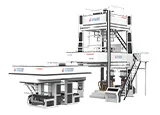
Hebei Chengheng Plastic Machinery Technology Co., Ltd. specializes in the research, development, and manufacture of blown film extrusion equipment, automatic air ring systems, online thickness measurement systems, and intelligent process-control technologies.
By combining extrusion engineering with advanced automation and process monitoring, the company supports plastic film manufacturers seeking improved production efficiency, stable film quality, reduced material waste, and greater flexibility in producing recyclable packaging solutions for international markets.
1. European Commission — Directorate-General for Environment
New EU rules on packaging enter into application — August 11, 2026.
2. European Commission — Directorate-General for Communication
New packaging rules for less waste and easier recycling — August 12, 2026.
3. European Commission
FAQ on Packaging and Packaging Waste Regulation (PPWR) — August 3, 2026.
4. ICIS
PPWR stretch-wrap guidance exposes contradictions over when film becomes packaging — August 7, 2026.
5. Reuters
EU packaging rules take effect with limits on 'forever chemicals', plastics curbs — August 11, 2026.
6. Plastics Information Europe (PIE)
Plastic packaging: High recyclate prices inhibit demand, restrict supply — August 18, 2026.